Global network of interconnected server racks placed across a stylized world map with glowing blue and purple data connection lines on a dark background
Think of your data living in dozens—or even thousands—of different locations simultaneously. That's essentially what happens with a distributed database. Instead of cramming everything onto one beefy server sitting in a closet somewhere, you're spreading information across multiple machines that might be in the same building, scattered across continents, or floating in various cloud regions.
Here's what makes this different from traditional setups: a distributed database system doesn't just backup your data to different places. It actively splits information into chunks and coordinates how those pieces work together. When someone queries the system, they don't need to know that Customer A's data lives in Singapore while Customer B's information sits in Frankfurt. The database figures out where everything is, grabs what's needed, and delivers results as though it's all coming from one place.
Why bother with this complexity? Because at a certain scale, you hit a wall. That single powerful server—no matter how much you soup it up—eventually can't handle the load. Adding more RAM or faster processors only gets you so far. But with a distributed approach, you can keep adding machines to handle growth. Need to support ten million more users? Spin up additional nodes. Simple in concept, though the execution gets interesting.
The coordination happening behind the scenes is genuinely sophisticated. When you insert a new customer record, the system applies its rules to decide where that information should land. Maybe it uses the customer's ZIP code, maybe it hashes their email address, or maybe it just round-robins across available servers. Then it creates copies on other nodes—insurance against hardware failures. Reading data involves querying the right nodes (sometimes simultaneously), collecting their responses, and assembling everything into a coherent answer.
Core Components of a Distributed Database System
You can't understand these systems without grasping their building blocks. Let's break down what actually makes everything tick.
Nodes are the individual servers doing the heavy lifting. Each one stores chunks of data and handles its share of queries. They're semi-autonomous—running their own operations while constantly chatting with peers to stay coordinated. A production cluster might have fifteen nodes for a mid-sized application or several thousand for something like Amazon's retail platform.
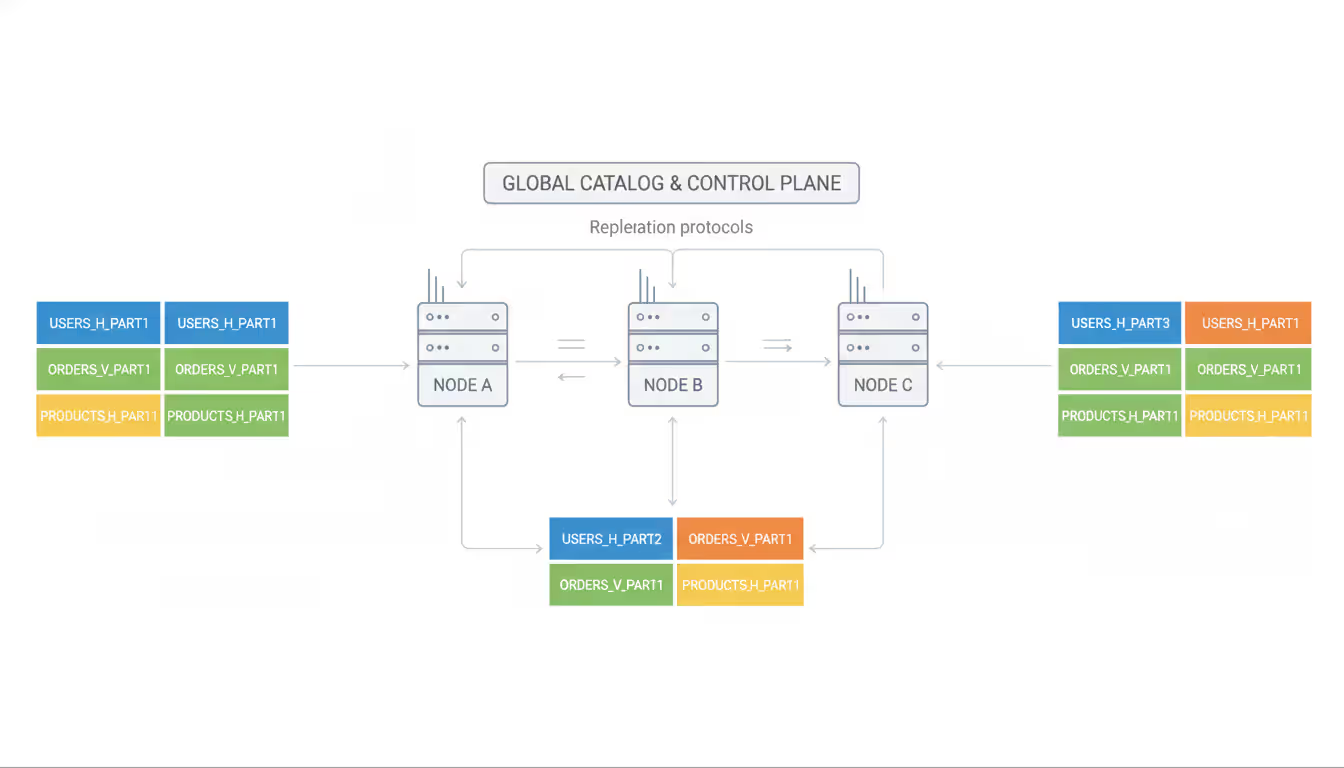
Data fragmentation is how the system divides your database into manageable pieces. Horizontal fragmentation slices tables by rows. Imagine an online retailer storing orders from January through June on Server 1, July through December on Server 2. Vertical fragmentation splits by columns instead—maybe keeping product names and prices on one node while relegating detailed descriptions and images to another. The fragmentation scheme you pick dramatically affects performance. Choose poorly and you'll have nodes constantly requesting data from each other just to answer basic queries.
Replication means making copies. Full replication duplicates everything everywhere—great for read-heavy workloads since any node can answer any query, but you're paying triple (or more) on storage costs. Partial replication is pickier, copying just your most-accessed tables or recent data. The replication factor tells you how many copies exist. Most teams settle on three replicas as a sweet spot between reliability and resource consumption.
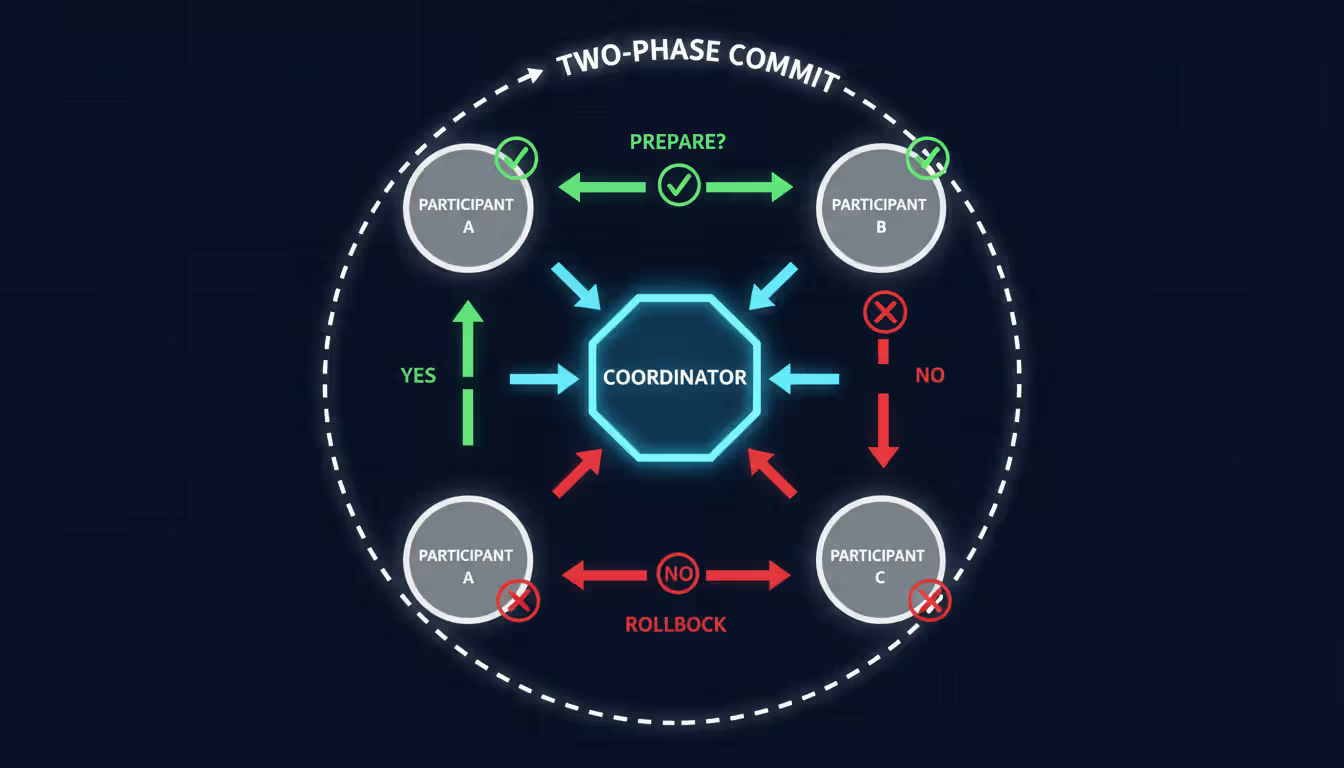
Communication protocols are the languages nodes speak to each other. These protocols route queries to the right places, sync data between replicas, detect when servers die, and reach consensus on important decisions. Two-phase commit ensures that transactions touching multiple nodes either complete everywhere or nowhere—preventing the nightmare scenario where money leaves one account but never arrives at the destination. Gossip protocols spread news about cluster changes efficiently, even with hundreds of participants.
The global catalog tracks where everything lives. It's essentially a map showing which fragments exist on which nodes, who's currently available, and how to route specific queries. This metadata layer lets your application treat the whole distributed mess as a single logical database.
Author: Nicole Bramwell;
Source: milkandchocolate.net
Distributed Database Architecture Explained
Architecture decisions ripple through everything—performance, complexity, failure modes, you name it. The choices you make about fragmentation, replication timing, and transparency mechanisms determine whether your distributed database architecture sings or struggles.
Horizontal fragmentation shines when your data naturally splits along some boundary. A SaaS company might fragment user tables by company ID, keeping each customer's data together on specific nodes. This works beautifully for queries filtering by that key—you hit one node instead of scanning everywhere. But ask for a report across all customers and suddenly you're gathering data from every node in the cluster.
Vertical fragmentation divides tables by column rather than row. Consider a user table with fifty fields. Authentication only needs username and password hash—why transfer birth date, preferences, and address across the network? Splitting frequently accessed columns from rarely used ones reduces bandwidth and speeds up common queries. The downside: joining those columns back together when you do need complete records adds latency.
Replication models come in synchronous and asynchronous flavors. Synchronous replication blocks writes until every replica confirms it received the data. You get guaranteed consistency—every node always shows identical information. But you're also waiting for the slowest replica in the chain, and if one fails, writes might stall entirely. Asynchronous replication says "message received" immediately and copies data to replicas in the background. Faster, but there's a window where nodes disagree about current values. If the primary crashes before syncing, recent writes vanish.
Transparency hides the distributed nature from applications. Location transparency means your app doesn't specify which node holds data—the system figures it out. Replication transparency conceals that five copies exist. Fragmentation transparency lets you query a table as though it's whole, not split across servers. Maximum transparency simplifies development but demands smart middleware that handles the complexity you're hiding.
Homogeneous vs. Heterogeneous Architecture
Homogeneous setups run identical software everywhere. Every node might be PostgreSQL 15.2, for instance. Administration becomes simpler—you're not juggling different config files, query syntaxes, or upgrade schedules. Replication works smoothly since everyone speaks the same language. Most modern distributed database systems go this route.
Heterogeneous architectures mix different database types. You might inherit this situation after acquiring another company running Oracle while your systems use MySQL. Or maybe you're deliberately using MongoDB for document storage alongside PostgreSQL for transactional data. Middleware translates between different query languages and data formats, but this flexibility costs you. Performance suffers, optimization gets harder, and your operations team needs expertise across multiple platforms.
Client-Server and Peer-to-Peer Models
Client-server architecture splits roles clearly. Certain nodes act as servers—storing data and processing requests. Client applications submit queries and display results. This pattern feels familiar because it mirrors traditional database setups. Servers can specialize: designate some for write operations, optimize others for analytical queries running against historical data.
Peer-to-peer models reject this hierarchy. Every node is equal, capable of accepting client requests and storing data. Cassandra exemplifies this approach—there's no master node whose failure brings everything down. Want more capacity? Add peers and they automatically join the coordination dance. The tradeoff: as clusters grow into hundreds or thousands of nodes, the coordination overhead increases. Keeping everyone synchronized requires more network chatter.
How Distributed Database Management Systems Handle Data
Query processing gets complicated fast when data lives in multiple places. The distributed database management system receives your query, parses it to understand what you want, figures out which nodes hold relevant data, generates execution plans for each fragment, ships those subqueries to appropriate nodes, and finally merges results. If you're joining customer and order tables that live on different servers, the optimizer might execute joins partially on each node, transferring only matching rows instead of moving entire tables across the network.
Transaction management ensures operations complete reliably despite everything being scattered. Consider transferring money between accounts. The withdrawal and deposit must both succeed or both fail—even if those accounts sit on servers separated by an ocean. Two-phase commit coordinates this dance: a coordinator asks all participating nodes to prepare the transaction. Only when everyone responds positively does it commit everywhere. If any node fails or votes against, the entire operation rolls back across all participants.
Concurrency control prevents chaos when multiple transactions access identical data simultaneously. Traditional locking reserves data for exclusive access, but distributed locks require cross-node coordination that introduces latency and deadlock risks. Optimistic concurrency control assumes conflicts rarely happen, validating only at commit time and retrying when conflicts appear. Multi-version concurrency control maintains several versions of each data item, letting readers access consistent snapshots without blocking writers.
ACID properties—Atomicity, Consistency, Isolation, Durability—guarantee reliable transactions but demand coordination that conflicts with distributed system performance goals. Many newer systems embrace BASE instead: Basically Available, Soft state, Eventually consistent. BASE accepts temporary inconsistencies across nodes in exchange for better availability and speed. Instagram can show you a like count that's thirty seconds stale. That's fine—the performance gains from relaxed consistency enable serving a billion users.
The CAP theorem demonstrates an unavoidable constraint: when networks fail and split your cluster into isolated groups, you must choose between consistency (refusing operations to prevent divergent data) and availability (serving requests despite potential inconsistencies). Most distributed databases let you tune this choice per operation or table.
Author: Nicole Bramwell;
Source: milkandchocolate.net
Advantages and Challenges of Distributed Database Systems
Scalability is why people tolerate the complexity. Well-designed distributed database systems scale nearly linearly. Transaction volume doubles? Double your cluster size and maintain similar performance. Centralized databases eventually hit physical limits—there's only so much RAM you can cram into one machine.
Fault tolerance improves dramatically. One node dies? Replicas on healthy nodes seamlessly take over. Geographic distribution protects against data center fires or regional disasters. Banks run these systems across continents so European customers keep banking even if North American infrastructure goes dark.
Performance benefits from parallelism and strategic data placement. Queries execute simultaneously across dozens of nodes, aggregating results far faster than sequential processing. Placing European customer data in Amsterdam means Paris-based applications see millisecond latencies instead of waiting for transatlantic round trips.
Complexity represents the main drawback. You need expertise in network engineering, consensus algorithms, and bizarre failure modes that centralized databases never encounter. Debugging becomes painful when issues involve subtle timing interactions between nodes. A query succeeding in testing might fail in production when network latency spikes.
Consistency issues plague these architectures. Keeping all nodes showing identical values requires coordination that conflicts with low latency. Your application must handle scenarios where different nodes return different answers for identical queries—maybe showing inventory as available on one replica but sold out on another.
Network dependency introduces entirely new failure categories. Networks partition, splitting clusters into groups that can't communicate. Slow networks delay replication, widening the window where data differs across nodes. Network transfer costs often exceed compute expenses when systems constantly move large datasets between nodes for joins or aggregations.
Operational overhead multiplies as you add nodes. Monitoring three hundred servers, coordinating software upgrades without downtime, and managing configuration consistency across the fleet demands automation that takes months to build properly. A misconfiguration corrupting data on one node might replicate everywhere before anyone notices.
Common Use Cases and Real-World Applications
Author: Nicole Bramwell;
Source: milkandchocolate.net
E-commerce sites rely heavily on these systems during peak shopping periods. Amazon distributes product catalogs, inventory counts, and customer profiles across geographic regions. Shoppers in Tokyo and Toronto get similar response times because data lives near them. Session information replicates globally so your shopping cart survives even if the original data center catches fire.
Financial institutions process massive transaction volumes across worldwide markets. A distributed database might partition stock trading data by exchange or asset type, enabling parallel processing while preserving complete audit trails. Regulations frequently mandate data residency—EU customer information must physically stay within European borders—making geographic fragmentation not just useful but legally required.
Social media platforms store billions of posts, relationships, and activity feeds. Facebook developed TAO specifically to handle their scale by partitioning data by user ID and heavily replicating popular profiles. Assembling your timeline requires aggregating posts from friends stored across different servers, then ranking and filtering everything before display.
IoT deployments gather sensor telemetry from millions of devices worldwide. Edge nodes near sensors might store recent readings for fast local queries while archiving historical data centrally for analysis. Smart city infrastructure monitoring traffic patterns, utility usage, and environmental conditions needs distributed databases processing locally but aggregating globally for planning.
Global corporations consolidate subsidiary data while respecting national sovereignty laws. A distributed database in dbms implementations lets headquarters query worldwide sales figures while ensuring each country's data physically resides within its borders—critical for GDPR and similar privacy regulations.
Distributed vs. Centralized Databases: Key Differences
Characteristic
Distributed Approach
Centralized Approach
Scaling strategy
Add more commodity servers horizontally; petabyte-scale capacity
Upgrade to larger hardware vertically; hits limits around terabytes
Handling failures
Operations continue when nodes fail; can span multiple geographic regions
Entire system depends on one server; failover requires expensive redundant configurations
Query speed
Executes queries across nodes simultaneously; places data near users globally
Single-node optimization excels; no network delays within queries
Financial impact
Cheaper individual servers but complex operations cost more
Expensive high-end hardware but simpler to manage
Operational difficulty
Demands distributed systems expertise; troubleshooting spans multiple components
Standard administration patterns; established best practices
Data agreement
Often eventually consistent; trade consistency for availability
Roll changes across nodes without downtime; maintain service during updates
Requires maintenance windows; service interruptions during upgrades
Your requirements drive the decision. Startups typically launch with centralized setups—simpler development and adequate for early growth. Migration to distributed architectures becomes necessary as user bases spread internationally or data volumes exceed what one server can handle, despite the operational complexity.
We're witnessing a fundamental shift in database thinking. The old model optimized around making one extremely powerful machine work perfectly. Modern distributed database systems optimize for resilience across hundreds of commodity servers instead. This changes everything—schema design, transaction semantics, failure recovery. But the scalability and fault tolerance you gain makes the learning curve worthwhile for internet-scale applications
— Dr. Sarah Chen
Frequently Asked Questions About Distributed Databases
What separates a distributed database from a decentralized one?
Distribution maintains central coordination—some consensus mechanism or master node controls the overall system even though data spreads across locations. Decentralized systems like blockchain eliminate central control completely. All nodes participate equally in governance and validation with no single authority. Distributed databases optimize for performance and consistency within an organization. Decentralized systems prioritize trustlessness and censorship resistance across untrusted parties.
How do these systems keep data consistent across nodes?
Mechanisms vary by design philosophy. Strong consistency protocols like two-phase commit or Paxos ensure all nodes agree before confirming writes—slower but guaranteeing identical data everywhere simultaneously. Eventual consistency allows temporary differences, propagating changes asynchronously until replicas converge—much faster but applications must tolerate occasionally stale reads. Many systems offer tunable consistency where developers choose appropriate guarantees per operation based on business requirements.
What architectural patterns do distributed databases use?
Primary patterns include shared-nothing where each node has independent storage and processors, shared-disk where nodes share storage but maintain separate processing, and shared-memory where both storage and memory are shared. Most modern implementations use shared-nothing for superior scalability. Another dimension: homogeneous architectures run identical software across all nodes while heterogeneous setups mix different database systems—the former being far more common today.
Does cloud storage equal a distributed database?
Not really. Cloud storage services like Amazon S3 distribute object storage across servers for durability and availability but lack database features. They store files—that's it. No indexing, no query languages, no transaction support. Distributed databases build atop similar infrastructure but add structured data management, SQL or NoSQL query interfaces, ACID or BASE guarantees, and sophisticated query optimization. Some distributed databases actually use cloud storage as their underlying persistence layer.
Which industries gain most from distributed architectures?
Industries handling enormous data volumes or serving global audiences benefit most. Financial services processing millions of trades daily, telecommunications managing subscribers across countries, healthcare networks sharing patient records between hospitals, retail chains synchronizing inventory across thousands of stores, and tech platforms serving billions of users worldwide. Any organization outgrowing single-server capacity or needing geographic distribution for performance should seriously consider these systems.
How does failure recovery work in distributed systems?
Replication provides the foundation. When a node fails, replicas on healthy nodes continue serving requests without interruption. The system detects failures through heartbeat checks or gossip protocols, marking failed nodes unavailable and rerouting traffic. Once a node recovers, it synchronizes with replicas to catch up on missed updates. Some systems replay write-ahead logs reconstructing recent transactions. For permanent failures, clusters automatically rebalance—copying data from existing replicas to healthy nodes until the desired replication factor is restored.
Distributed databases solve problems centralized architectures simply can't: internet-scale data volumes, global users demanding low latency, and availability requirements exceeding any single server's reliability. The operational complexity and debugging challenges are genuine—troubleshooting distributed transactions or resolving split-brain scenarios demands expertise many teams initially lack.
You should adopt distributed database systems when specific needs justify the complexity: data volumes exceeding what one server handles, user bases spanning continents where proximity matters for experience, or availability demands requiring redundancy across failure zones. Starting with managed services like Amazon DynamoDB or Google Cloud Spanner reduces operational burden while delivering distributed benefits.
The technology keeps improving. Modern systems increasingly automate sharding, replication, and failover—tasks requiring manual intervention five years ago. Consensus algorithms have gotten faster, reducing coordination overhead. Query optimizers handle distributed joins better. These advances make distributed databases accessible to smaller organizations that couldn't justify the investment previously.
Success requires matching architecture to workload characteristics. Analytical queries aggregating massive datasets need different optimizations than transactional workloads with frequent small updates. Understanding your access patterns, consistency requirements, and failure tolerance guides technology selection. The landscape offers options from strongly consistent relational systems to eventually consistent NoSQL stores—choosing wisely means analyzing your specific situation rather than following hype.
Every network device carries a unique MAC address identifier. This guide shows you how to find MAC addresses using command-line tools, system settings, and vendor lookup databases. Includes step-by-step instructions for Windows Command Prompt, macOS, Linux, and mobile devices
Migrating to the cloud doesn't always require reimagining your entire infrastructure. Lift and shift migration moves applications to the cloud with minimal modifications—a pragmatic approach for organizations facing data center deadlines or managing legacy systems
Network failures don't announce themselves politely. For small and medium businesses, disruptions translate directly into lost revenue and damaged reputation. This guide explains IT network support services, when you need professional help, and how to choose between in-house teams and managed providers
Building your own cloud storage gives you complete control over your data while potentially saving money compared to subscription services. This comprehensive guide covers hardware requirements, software platforms like Nextcloud, step-by-step installation, security best practices, and common mistakes to avoid
The content on this website is provided for general informational purposes only. It is intended to offer insights, commentary, and analysis on cloud computing, network infrastructure, cybersecurity, and IT solutions, and should not be considered professional, technical, or legal advice.
All information, articles, and materials presented on this website are for general informational purposes only. Technologies, standards, and best practices may vary depending on specific environments and may change over time. The application of any technical concepts depends on individual systems, configurations, and requirements.
This website is not responsible for any errors or omissions in the content, or for any actions taken based on the information provided. Users are encouraged to seek qualified professional advice tailored to their specific IT infrastructure, security, and business needs before making decisions.