Digital shield with layered cybersecurity protection surrounded by laptop, smartphone, cloud server, and encrypted connection lines on dark blue background
The perimeter-based security model that protected corporate networks for decades has collapsed. Employees work from coffee shops, home offices, and airport lounges. Applications live in AWS, Azure, and SaaS platforms. Traditional VPNs grant broad network access based on a single authentication event, creating massive attack surfaces that threat actors exploit daily.
Zero trust VPN represents a fundamental shift in how organizations secure remote access. Rather than extending trust across an entire network once credentials check out, this approach treats every access request as potentially hostile, verifying identity and device posture continuously before granting minimal necessary permissions.
What Is Zero Trust VPN and How Does It Work
A zero trust VPN operates on the principle that no user or device deserves implicit trust, regardless of network location. Unlike conventional VPNs that create encrypted tunnels granting access to entire network segments, zero trust VPN solutions authenticate users and devices for each specific resource they attempt to access.
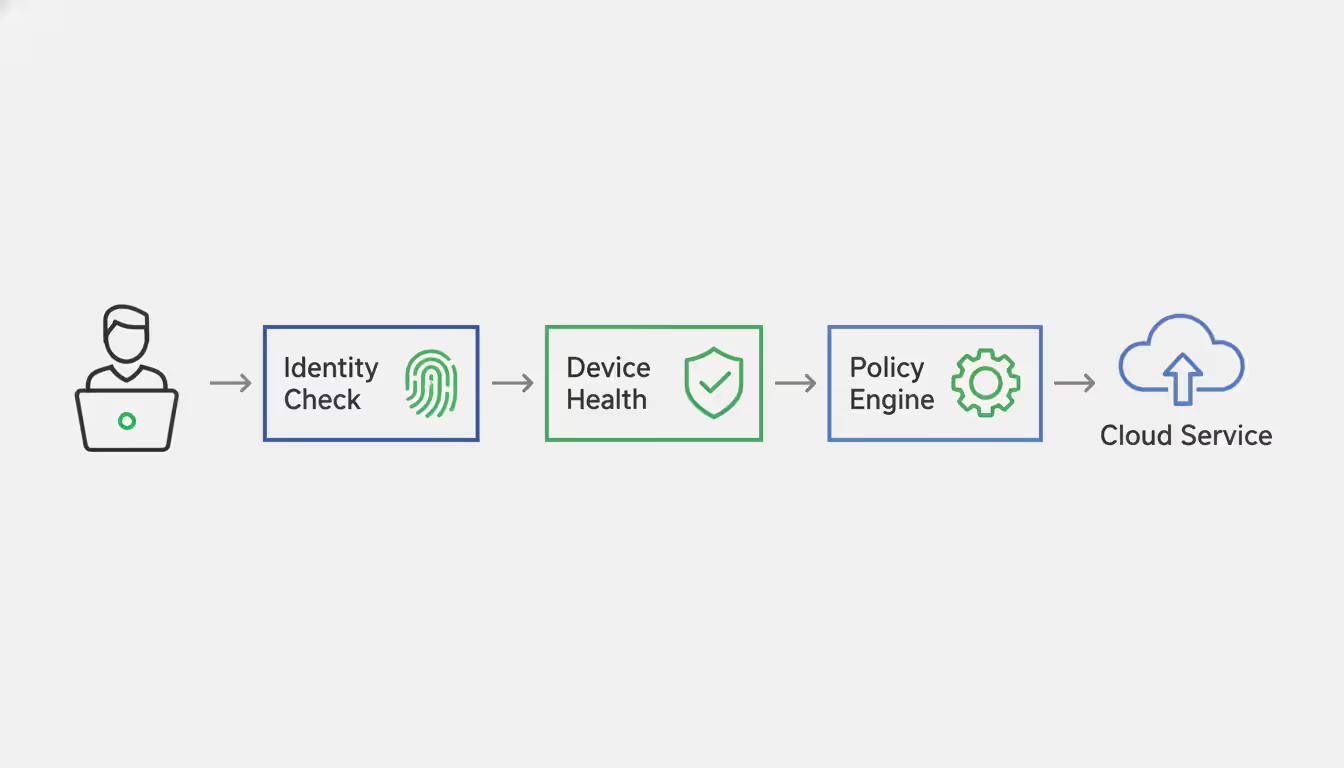
The core mechanism involves several continuous verification steps. When an employee attempts to reach an application, the system first validates their identity through multi-factor authentication. Simultaneously, it assesses device health—checking for updated security patches, active endpoint protection, and compliance with corporate policies. Only after passing both checks does the policy engine evaluate whether that specific user, on that particular device, at that moment, should access the requested resource.
This architecture eliminates the "castle-and-moat" assumption that dominated zero trust networking for years. A compromised credential no longer provides an attacker with lateral movement capabilities across your infrastructure. Each application connection requires fresh verification, and users never gain visibility into resources they don't explicitly need.
The policy engine sits at the heart of zero trust VPN functionality. It evaluates contextual signals—user role, device posture, location, time of day, requested resource sensitivity—against granular access policies. A finance manager might access payroll systems from a managed laptop during business hours but face additional verification requirements when connecting from a personal tablet at midnight.
Author: Evan Crossfield;
Source: milkandchocolate.net
Micro-segmentation enforces these decisions at the network level. Rather than placing users on VLANs with access to hundreds of systems, zero trust VPN creates one-to-one encrypted connections between verified users and specific applications. This dramatically reduces the attack surface. Ransomware spreading from an infected device can't pivot to adjacent systems because those network paths simply don't exist from the user's perspective.
Zero Trust Networking vs Traditional VPN Architecture
Traditional VPN architecture assumes that authenticated users are trustworthy. Once employees provide valid credentials, they receive network access equivalent to sitting in the office. This made sense when "the office" was the only place sensitive data lived and employees used company-owned desktops. That world no longer exists.
Zero trust networking inverts this model entirely. Authentication is continuous rather than one-time. Trust is never assumed but constantly evaluated. Access is application-specific rather than network-wide.
Author: Evan Crossfield;
Source: milkandchocolate.net
Key Differences in Access Control
Legacy VPNs operate at the network layer, routing all traffic through encrypted tunnels to corporate data centers. Users authenticate once, then move freely across permitted network segments. Firewall rules provide coarse-grained control—entire departments might share access to the same subnets.
Zero trust VPN enforces access at the application layer. Users connect directly to specific applications through the policy engine, which acts as an invisible intermediary. The underlying network topology becomes irrelevant. An application running in your data center receives the same protection model as one hosted in Google Cloud.
This application-centric approach eliminates a common attack pattern. When hackers compromise traditional VPN credentials, they gain a foothold for reconnaissance—scanning internal networks, identifying vulnerable systems, and moving laterally. Zero trust VPN users can't perform network scans because they never receive actual network access. They interact with authorized applications through isolated, encrypted connections.
Authentication and Verification Methods
Traditional VPNs authenticate users at connection time. Many organizations still rely on username and password combinations, though more mature deployments require multi-factor authentication. Once connected, that authentication remains valid for the entire session—sometimes hours or days.
Zero trust VPN treats authentication as a continuous process. Initial access requires strong identity verification, typically combining something you know (password), something you have (hardware token or push notification), and increasingly something you are (biometric verification). But verification doesn't stop there.
Device posture checking runs continuously throughout the session. If a user's laptop suddenly shows signs of malware—unexpected processes, disabled security controls, or suspicious network activity—the system can immediately revoke access to sensitive resources without terminating legitimate work in progress.
Contextual signals influence authentication requirements dynamically. Accessing low-sensitivity resources from a known device on a familiar network might require standard multi-factor authentication. The same user attempting to download customer databases from a new device in an unusual location would face additional verification steps—perhaps requiring approval from a security team member or restricting access entirely.
Feature
Traditional VPN
Zero Trust VPN
Access model
Network-level access to segments
Application-level access per resource
Authentication
One-time at connection
Continuous verification throughout session
Trust assumption
Trust after authentication
Never trust, always verify
Network visibility
Users see all permitted network segments
Users see only authorized applications
User experience
Full tunnel routing, often slower
Direct-to-app connections, typically faster
Security posture
Large attack surface with lateral movement
Minimal attack surface with isolated connections
Zero Trust Architecture Diagram Explained
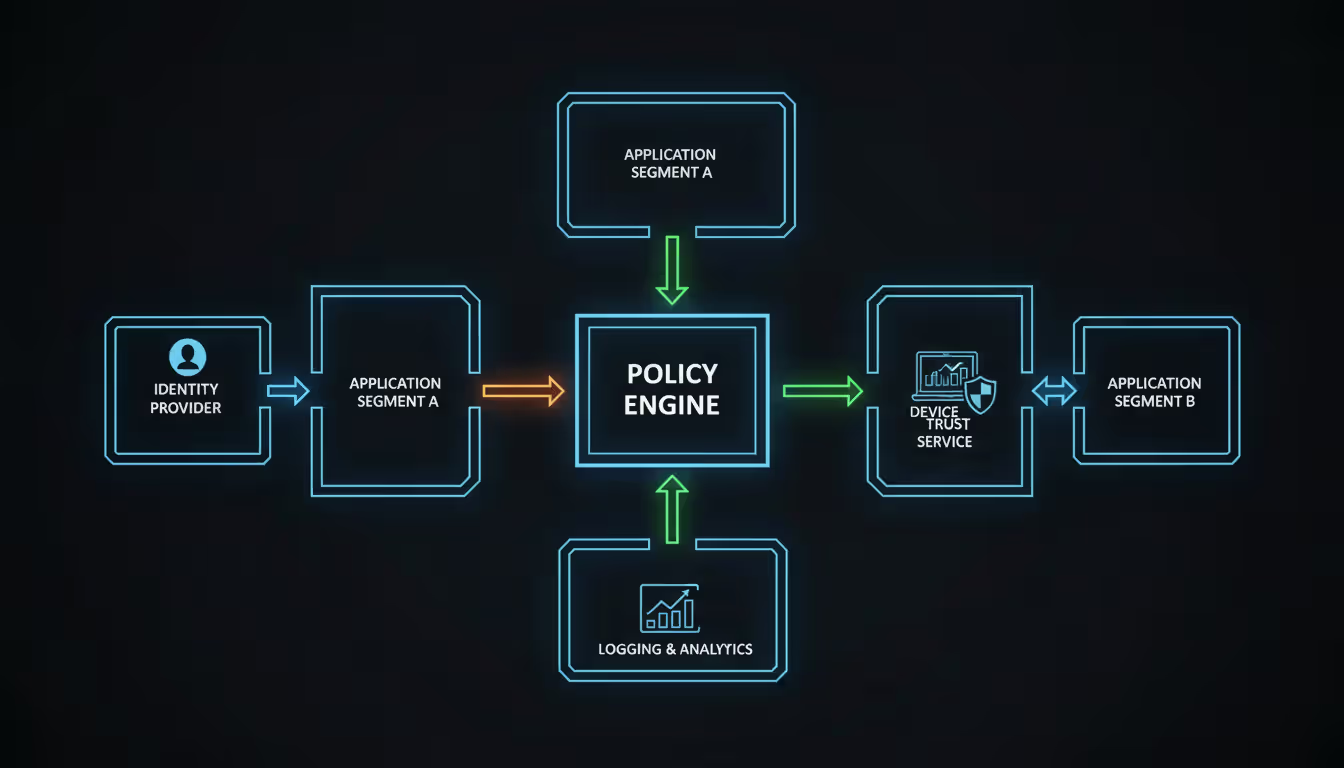
Visualizing zero trust architecture helps clarify how components interact to enforce security policies. While implementations vary by vendor and organizational requirements, several elements appear consistently across zero trust architecture diagrams.
The identity provider sits at the foundation, maintaining authoritative user records and authentication mechanisms. This might be Active Directory, Okta, Azure AD, or another identity management system. Every access request begins with identity verification against this source of truth.
Device trust services run parallel to identity verification. These components assess endpoint health—operating system patch levels, antivirus status, disk encryption, and compliance with corporate security policies. An up-to-date laptop managed by IT receives higher trust scores than a personal smartphone with unknown security posture.
Author: Evan Crossfield;
Source: milkandchocolate.net
The policy engine receives inputs from both identity and device trust services, combining them with contextual signals—IP address, geolocation, time of day, requested resource sensitivity. It evaluates these factors against administrator-defined policies to make access decisions. This engine operates as the brain of zero trust networking, translating abstract security requirements into concrete allow/deny decisions.
Micro-segmentation infrastructure enforces policy engine decisions at the network level. Rather than traditional firewalls protecting network perimeters, micro-segmentation creates isolated communication paths between verified users and specific applications. These paths exist only for the duration of authorized sessions and provide no visibility into adjacent systems.
Application connectors or gateways sit in front of protected resources, intercepting access requests and coordinating with the policy engine. Users never communicate directly with applications—every interaction flows through these intermediaries, which enforce encryption, log activity, and terminate connections when policies change.
Logging and analytics systems capture every access decision, authentication event, and policy evaluation. This telemetry feeds security information and event management (SIEM) platforms, enabling threat detection, compliance reporting, and continuous policy refinement. Organizations gain unprecedented visibility into who accesses what, when, and from where.
Choosing a Zero Trust VPN Solution for Your Organization
Evaluating zero trust VPN solutions requires balancing security requirements, user experience expectations, and operational complexity. Organizations that rush implementation without careful assessment often face employee resistance, integration nightmares, or security gaps that defeat the entire purpose.
Identity integration capabilities should top your evaluation criteria. Your zero trust VPN solution must work seamlessly with existing identity providers. Native support for SAML, OIDC, and LDAP protocols is table stakes. Look deeper at how solutions handle complex scenarios—nested group memberships, dynamic role assignments, and identity federation across multiple directories.
Device posture checking sophistication varies dramatically between vendors. Basic solutions verify operating system versions and check for running antivirus software. Advanced platforms assess dozens of security controls—disk encryption status, screen lock settings, jailbreak detection on mobile devices, and real-time threat indicators. Consider your compliance requirements and risk tolerance when evaluating these capabilities.
Policy granularity determines how precisely you can control access. Some solutions offer only broad rules—"developers can access staging environments." Others support attribute-based access control with fine-grained conditions—"senior developers can access production databases from corporate laptops during business hours, but only read-only access from personal devices, and never from high-risk countries." More granular policies mean better security but increased configuration complexity.
Cloud compatibility matters increasingly as workloads migrate off-premises. Your zero trust VPN solution should protect applications regardless of hosting location—on-premises data centers, AWS, Azure, Google Cloud, or SaaS platforms. Verify that the solution can enforce consistent policies across hybrid environments without requiring separate configurations for each hosting model.
Scalability concerns extend beyond user count. Consider connection patterns—do employees access three applications daily or thirty? How many concurrent sessions will the system handle during peak hours? What happens when you acquire another company and need to onboard five thousand users in two weeks? Architectures that work for five hundred users sometimes collapse under enterprise loads.
Criteria
What to Look For
Why It Matters
Identity integration
Native support for your IdP, federation capabilities, attribute mapping
Seamless user experience, reduced authentication friction, centralized identity management
Device posture checking
Depth of security controls assessed, real-time monitoring, remediation workflows
Prevents compromised devices from accessing sensitive resources, maintains compliance
Protects applications regardless of location, simplifies hybrid environment management
Scalability
User capacity, connection limits, geographic distribution, acquisition readiness
Avoids performance bottlenecks, supports business growth, enables rapid expansion
Zero Trust and SASE Integration
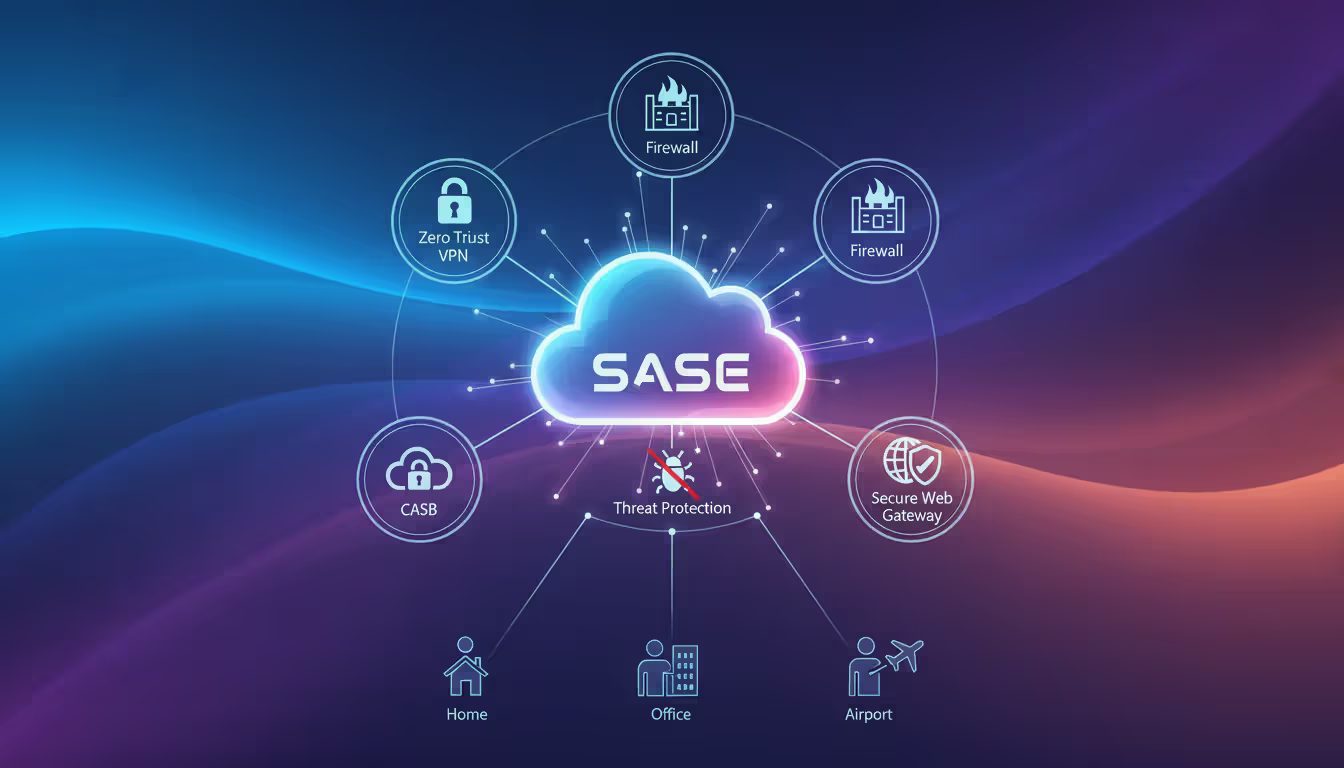
Secure Access Service Edge (SASE) frameworks converge networking and security into cloud-delivered services. Zero trust VPN represents a critical component within this architecture, handling secure remote access while other SASE elements provide cloud security, threat protection, and data loss prevention.
The convergence makes practical sense. Traditional approaches required separate products for VPN, firewall, web gateway, and cloud access security. Each product demanded its own management console, policy language, and expertise. SASE consolidates these functions into integrated platforms where zero trust VPN solutions share context with other security services.
This integration enables powerful security scenarios. When a user accesses a SaaS application through your zero trust and SASE platform, the system can simultaneously verify identity, check device posture, scan traffic for malware, inspect for data exfiltration attempts, and enforce acceptable use policies—all without deploying multiple agents or routing traffic through complex policy chains.
Cloud-native architectures deliver performance benefits that legacy VPN concentrators can't match. Rather than backhauling all traffic through corporate data centers, SASE platforms connect users to the nearest point of presence. An employee in Singapore accesses applications through Asian infrastructure, while their colleague in Frankfurt uses European resources. Both receive consistent security policies without the latency penalties of traditional hub-and-spoke VPN designs.
Vendor consolidation within SASE frameworks reduces operational complexity but increases vendor lock-in risk. Organizations replacing best-of-breed security tools with integrated SASE platforms gain simplified management at the cost of flexibility. Carefully evaluate whether your zero trust VPN solution needs to operate within a comprehensive SASE platform or should remain a standalone component integrated through APIs.
Zero Trust NAC and Device Verification
Network Access Control (NAC) evolved from simple port security into sophisticated device verification systems. Zero trust NAC extends these capabilities, continuously assessing endpoint compliance and health throughout user sessions rather than just at connection time.
The relationship between zero trust NAC and zero trust VPN often confuses organizations. NAC focuses on device verification—ensuring endpoints meet security baselines before and during network access. Zero trust VPN handles secure application access based on verified identity and device posture. These functions complement each other within comprehensive zero trust networking architectures.
Modern zero trust NAC solutions assess dozens of device attributes. Operating system versions, installed applications, running processes, security control status, and configuration compliance all factor into trust scores. Devices failing critical checks—disabled endpoint protection, missing security patches, or detected malware—receive restricted access or quarantine until remediation occurs.
Endpoint compliance extends beyond security software. Zero trust NAC can verify that devices meet corporate standards for disk encryption, screen lock timeouts, and even installed certificate authorities. A contractor's laptop lacking required encryption might access low-sensitivity collaboration tools but face blocks when attempting to reach customer data.
Continuous authentication represents the convergence of zero trust NAC and zero trust VPN principles. Rather than granting access based on login credentials and initial device checks, systems continuously monitor both identity signals (behavioral biometrics, session patterns) and device signals (security control status, threat indicators). Access adapts dynamically as trust levels change throughout work sessions.
Organizations implementing zero trust NAC alongside zero trust VPN solutions see 60% fewer security incidents related to compromised endpoints. The continuous verification model catches threats that bypass initial authentication checks
— Chase Cunningham
Common Implementation Challenges and Solutions
Migration from legacy VPN infrastructure to zero trust VPN solutions trips up even sophisticated IT organizations. The challenges span technical complexity, user experience concerns, policy design, and budget constraints.
Legacy application compatibility causes the most frequent implementation headaches. Applications designed for flat networks don't always function properly when accessed through zero trust VPN solutions that enforce strict micro-segmentation. Server-to-server communication patterns break when systems can't discover each other through network broadcasts. Older protocols that embed IP addresses in application data fail when network topology becomes abstracted.
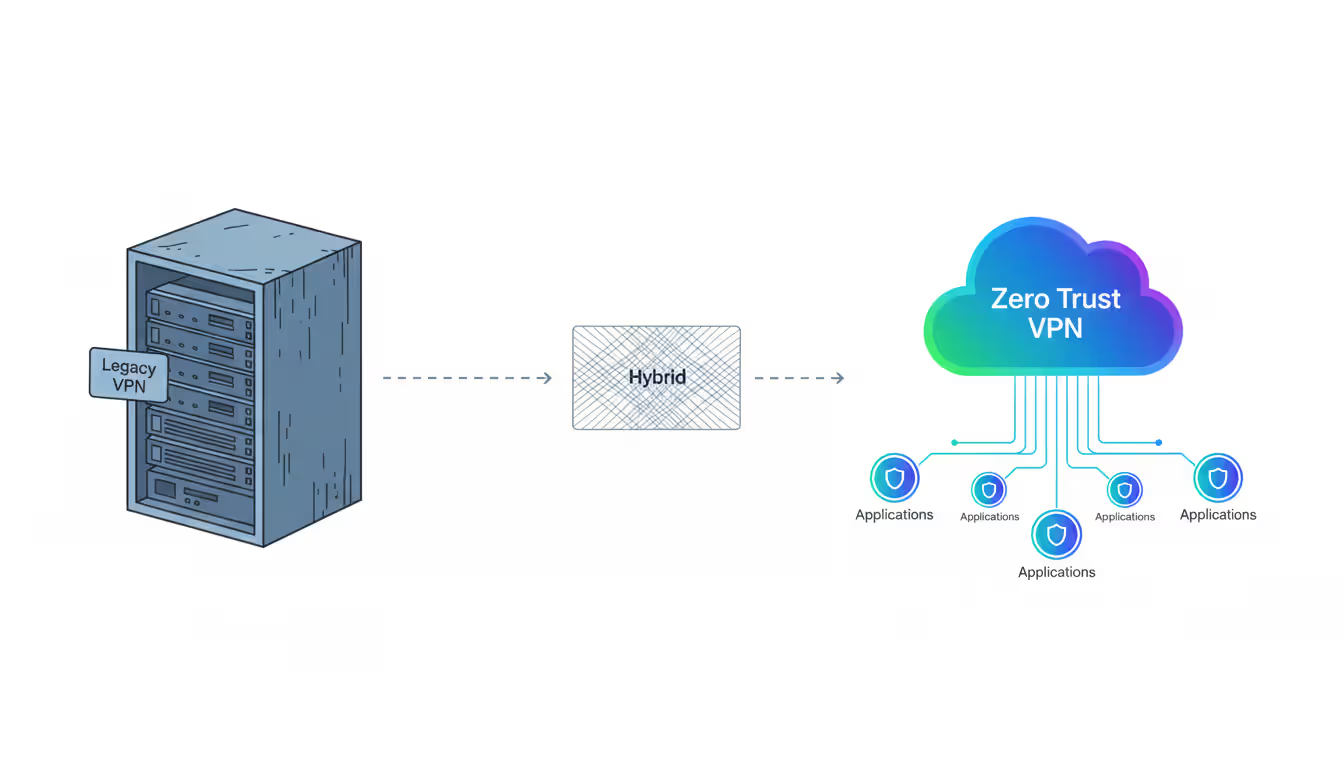
The solution involves hybrid architectures during transition periods. Keep legacy VPN access for problematic applications while migrating modern workloads to zero trust VPN. This approach extends migration timelines but prevents business disruption. Plan for 18-24 months to fully transition complex environments rather than attempting big-bang replacements.
User experience concerns emerge when zero trust VPN implementations add authentication friction without clear security benefits. Employees forced to approve push notifications for every application access quickly develop alert fatigue. Overly aggressive device posture checking that blocks access from slightly outdated laptops creates helpdesk floods and productivity losses.
Author: Evan Crossfield;
Source: milkandchocolate.net
Balance security requirements against usability through risk-based policies. Low-sensitivity resources might require strong initial authentication but minimal ongoing verification. High-value systems warrant continuous checks and additional authentication steps. Communicate security benefits clearly—employees tolerate reasonable friction when they understand the protection it provides.
Policy configuration complexity scales exponentially with organization size and application count. Defining granular access rules for thousands of users and hundreds of applications overwhelms teams accustomed to simple network firewall rules. Many organizations create overly permissive policies initially, defeating zero trust principles, then struggle to tighten controls without breaking workflows.
Start with broad policies based on job roles and application sensitivity tiers. Monitor access patterns for several months, identifying actual usage versus assumed requirements. Gradually refine policies based on observed behavior rather than theoretical models. Expect policy tuning to continue indefinitely—zero trust VPN isn't a set-and-forget technology.
Cost factors extend beyond licensing fees. Zero trust VPN solutions require identity infrastructure investments, endpoint management capabilities, and often network architecture changes. Organizations accustomed to $50-per-user annual VPN costs face sticker shock at $150-300 per user for comprehensive zero trust platforms. However, these comparisons ignore the security and operational benefits that justify higher investments.
Calculate total cost of ownership including reduced security incident expenses, eliminated VPN concentrator hardware, decreased network complexity, and improved user productivity from faster application access. Many organizations find that comprehensive zero trust VPN solutions cost less than maintaining legacy infrastructure while responding to frequent security breaches.
Frequently Asked Questions About Zero Trust VPN
Is zero trust VPN the same as a regular VPN?
Zero trust VPN and traditional VPN serve similar purposes—enabling secure remote access—but operate fundamentally differently. Regular VPNs create encrypted tunnels granting network-level access after one-time authentication. Zero trust VPN enforces application-level access with continuous verification of identity and device posture. Users never receive actual network access, only connections to specific authorized applications.
Do I still need a VPN with zero trust architecture?
Zero trust architecture doesn't eliminate the need for secure remote access—it transforms how that access works. You need zero trust VPN capabilities, but not traditional VPN technology. Organizations implementing comprehensive zero trust networking typically phase out legacy VPN concentrators, replacing them with zero trust VPN solutions that enforce modern security principles while providing better user experiences.
How much does a zero trust VPN solution cost?
Pricing varies dramatically based on feature sets, user counts, and deployment models. Basic cloud-delivered solutions start around $10-15 per user monthly. Enterprise platforms with advanced device posture checking, comprehensive policy engines, and SASE integration range from $25-50 per user monthly. Self-hosted solutions require additional infrastructure costs. Calculate total cost of ownership including reduced security incident expenses and eliminated legacy VPN hardware.
Can zero trust VPN work with remote employees?
Zero trust VPN is specifically designed for remote employee scenarios. Unlike traditional VPNs that perform poorly over consumer internet connections, zero trust VPN solutions connect users directly to applications through optimized cloud infrastructure. Remote employees often experience better performance than with legacy VPN because traffic doesn't backhaul through corporate data centers. The continuous device verification also provides stronger security for endpoints outside corporate control.
What's the difference between zero trust NAC and zero trust VPN?
Zero trust NAC focuses on device verification and endpoint compliance, ensuring devices meet security standards before and during network access. Zero trust VPN handles secure application access based on verified identity and device posture. These technologies complement each other—NAC provides device trust signals that zero trust VPN policy engines use when making access decisions. Many comprehensive platforms integrate both capabilities into unified solutions.
How long does it take to implement zero trust VPN?
Implementation timelines range from three months for small organizations with simple application portfolios to 18-24 months for enterprises with complex legacy infrastructure. Pilot deployments covering a few applications and user groups typically take 4-8 weeks. The longest phases involve application discovery, policy design, and gradual migration from legacy VPN. Organizations should plan for iterative rollouts rather than complete transitions, maintaining hybrid architectures during extended migration periods.
Zero trust VPN represents more than a technology upgrade—it's a fundamental shift in how organizations approach network security. The perimeter-based assumptions that guided VPN design for decades no longer align with how employees work or where applications live.
Implementation success depends on realistic expectations and careful planning. Organizations that treat zero trust VPN as a simple VPN replacement inevitably struggle with unexpected complexity, user resistance, and policy gaps. Those that approach it as a comprehensive security transformation—involving identity teams, application owners, and business stakeholders—achieve stronger security postures with better user experiences.
The convergence of zero trust VPN with broader SASE frameworks will accelerate through 2026 and beyond. Standalone point solutions will give way to integrated platforms that combine secure access, threat protection, and data security into cloud-delivered services. Organizations beginning zero trust VPN evaluations today should consider how their choices align with longer-term SASE strategies.
Start with clear objectives beyond "implement zero trust." Define specific security outcomes—reduced lateral movement risk, improved compliance posture, better visibility into application access. Measure progress against these outcomes rather than implementation milestones. Zero trust VPN delivers value through sustained security improvements, not just successful deployments.
The question isn't whether to adopt zero trust VPN principles, but how quickly you can transition from legacy architectures that assume trust to modern approaches that verify continuously. Every day spent on traditional VPN infrastructure is another day of excessive attack surface and preventable security risk.
WiFi 6E adds 59 channels in the 6 GHz band, providing clean spectrum for high-speed connections. Learn how channel allocation works, real-world speed differences versus WiFi 6, tri-band operation, and whether the technology justifies the cost premium for your specific environment
Organizations with distributed locations depend on reliable WAN connectivity. This guide covers monitoring methods, performance metrics, common issues, tool selection, and implementation best practices to maintain network health across geographic distances
Web based and cloud based systems differ fundamentally in infrastructure, scalability, and costs. Web based systems run on fixed servers with predictable expenses, while cloud platforms offer elastic scaling with usage-based pricing. Learn which architecture fits your monitoring, remote access, or enterprise needs
Remote file transfers are essential for distributed work. This comprehensive guide covers practical methods from Windows RDP to network shares and SSH protocols, with step-by-step instructions, troubleshooting tips, and security practices that protect your data during transit
The content on this website is provided for general informational purposes only. It is intended to offer insights, commentary, and analysis on cloud computing, network infrastructure, cybersecurity, and IT solutions, and should not be considered professional, technical, or legal advice.
All information, articles, and materials presented on this website are for general informational purposes only. Technologies, standards, and best practices may vary depending on specific environments and may change over time. The application of any technical concepts depends on individual systems, configurations, and requirements.
This website is not responsible for any errors or omissions in the content, or for any actions taken based on the information provided. Users are encouraged to seek qualified professional advice tailored to their specific IT infrastructure, security, and business needs before making decisions.